Why Ramsden? The point of view behind Practical Allyship
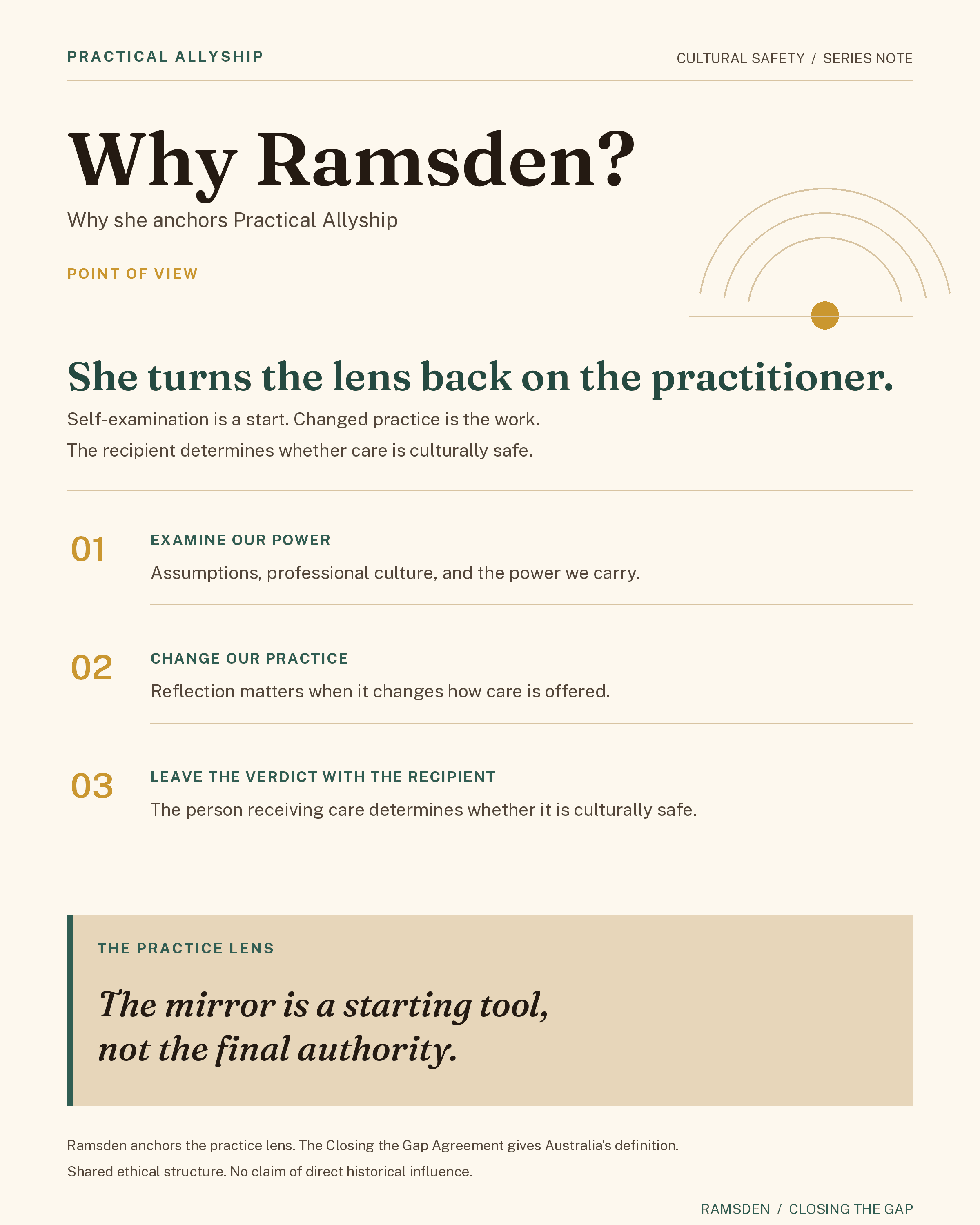
I chose Irihapeti Ramsden as the point of view for Practical Allyship because her work puts responsibility on practitioners and services. We examine our assumptions, professional culture and power, then change practice. The person receiving care retains the authority to determine whether the result is culturally safe.
Why Ramsden anchors the series
Ramsden was a Māori nurse and educator in Aotearoa New Zealand. In her doctoral thesis, she traces cultural safety through her own nursing experience and the development of the concept in nursing education and practice.
In her 2002 doctoral thesis, Ramsden wrote, “Cultural Safety is therefore about the nurse rather than the patient.” She also described safety as “a subjective word deliberately chosen to give the power to the consumer.” Both quotations are on printed page 6 of the thesis. Read Ramsden’s thesis (PDF hosted by Croakey).
I chose her because she links self-examination to changed practice. Practitioners must look at our assumptions, professional culture and power, then act on what that examination reveals. Reflection is a starting tool, not the outcome.
That is the movement Practical Allyship carries: self-examination → power → changed practice → recipient determination.
Why include the Closing the Gap Agreement
Australia has its own definition of cultural safety in the National Agreement on Closing the Gap. The Agreement calls for overcoming power imbalances of places, people and policies through action from the majority position. It states that only the Aboriginal and Torres Strait Islander person receiving a service or interaction can determine whether it is culturally safe. Read the Agreement’s definition.
Ramsden’s work is grounded in Māori cultural safety in Aotearoa. It does not stand in for Aboriginal and Torres Strait Islander knowledge or authority in Australia. I bring the two together because they illuminate related but distinct parts of the argument: Ramsden anchors the practitioner-facing lens; the Agreement gives the Australian definition and makes recipient authority explicit. I am not claiming that the Agreement’s drafters drew on Ramsden.
What Practical Allyship asks of us
Practical allyship is action on our side: notice assumptions, interrogate power, look outward, change practice, and check the effect. We can create conditions for culturally safe care. We cannot declare that care culturally safe. Aboriginal and Torres Strait Islander people determine whether it is.
That is why I chose Ramsden as the point of view for Practical Allyship. Her work keeps our attention on what we must change, and on whose judgement counts.
The pocket guides put this point of view into everyday practice. Start with the guide closest to your role.
THE POCKET GUIDES
Short, plain-language guides that carry this into a working day. Start with one.
See the pocket guides